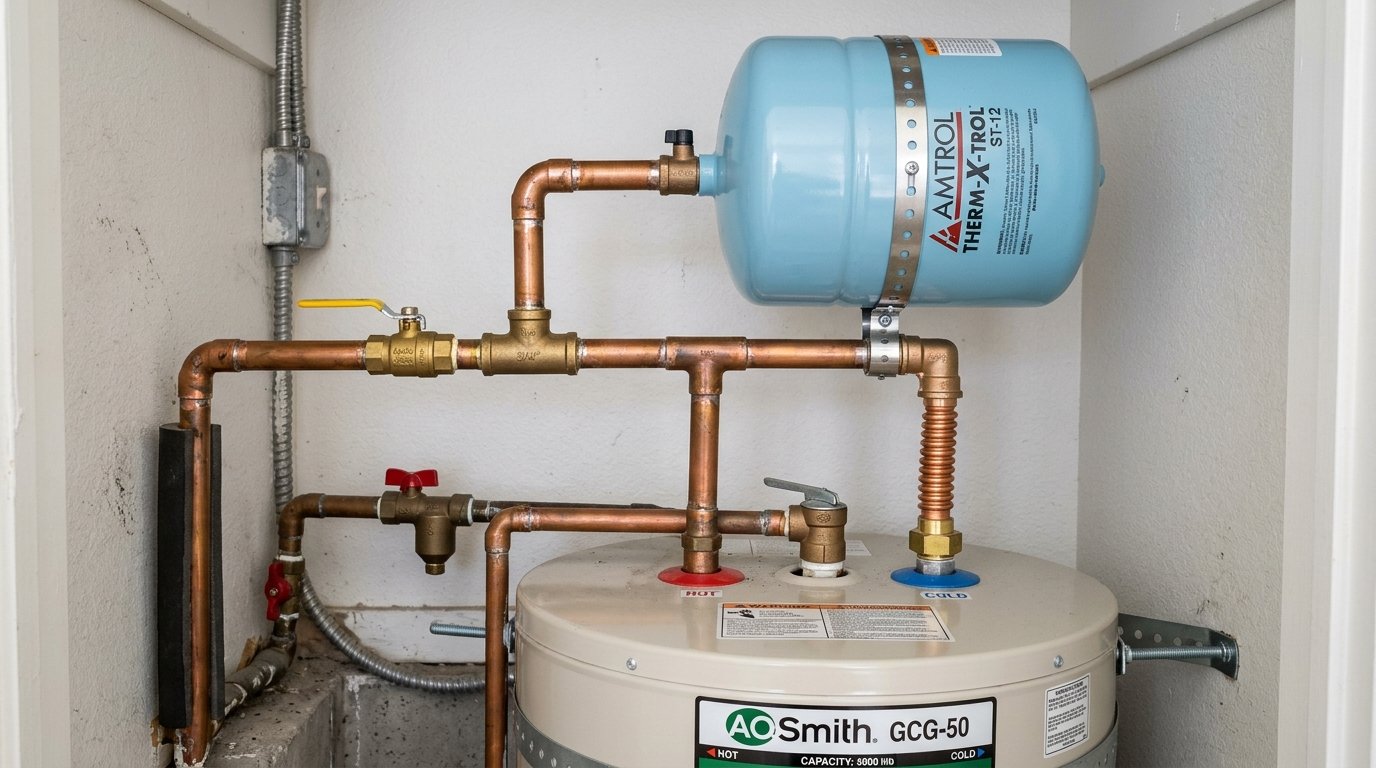
When replacing a water heater in Los Angeles, many homeowners are surprised when their plumbing quote includes an item called a thermal expansion tank—a small steel cylinder (usually painted blue or beige) mounted on the cold water pipe directly above the heater. Some wonder: "Is this an unnecessary upsell, or is it an actual building code requirement?"
The short answer: in virtually 100% of modern Los Angeles residences, an expansion tank is mandatory under California Plumbing Code (CPC) Section 608.3. Operating a storage water heater without one not only fails city inspection but causes chronic pressure damage to household plumbing fixtures.
The Physics of Thermal Expansion: Why Water Needs Somewhere to Go
Water is physically incompressible. When 50 gallons of cold municipal tap water (at 55°F) enters your water heater tank and is heated to standard domestic delivery temperature (125°F–130°F), it expands in volume by approximately 2% to 2.5%. That means an extra gallon to gallon-and-a-half of physical water volume is suddenly created inside a sealed metal cylinder.
In older, "open" plumbing systems from the 1950s, this extra water expanded backwards through the service meter into the city water main with zero issue. However, modern plumbing infrastructure across the San Fernando Valley and Los Angeles is strictly designed as a closed system.
Why Modern LA Homes Are Classified as "Closed Systems"
Your home's plumbing is classified as closed if any device prevents water from flowing backwards into the street main:
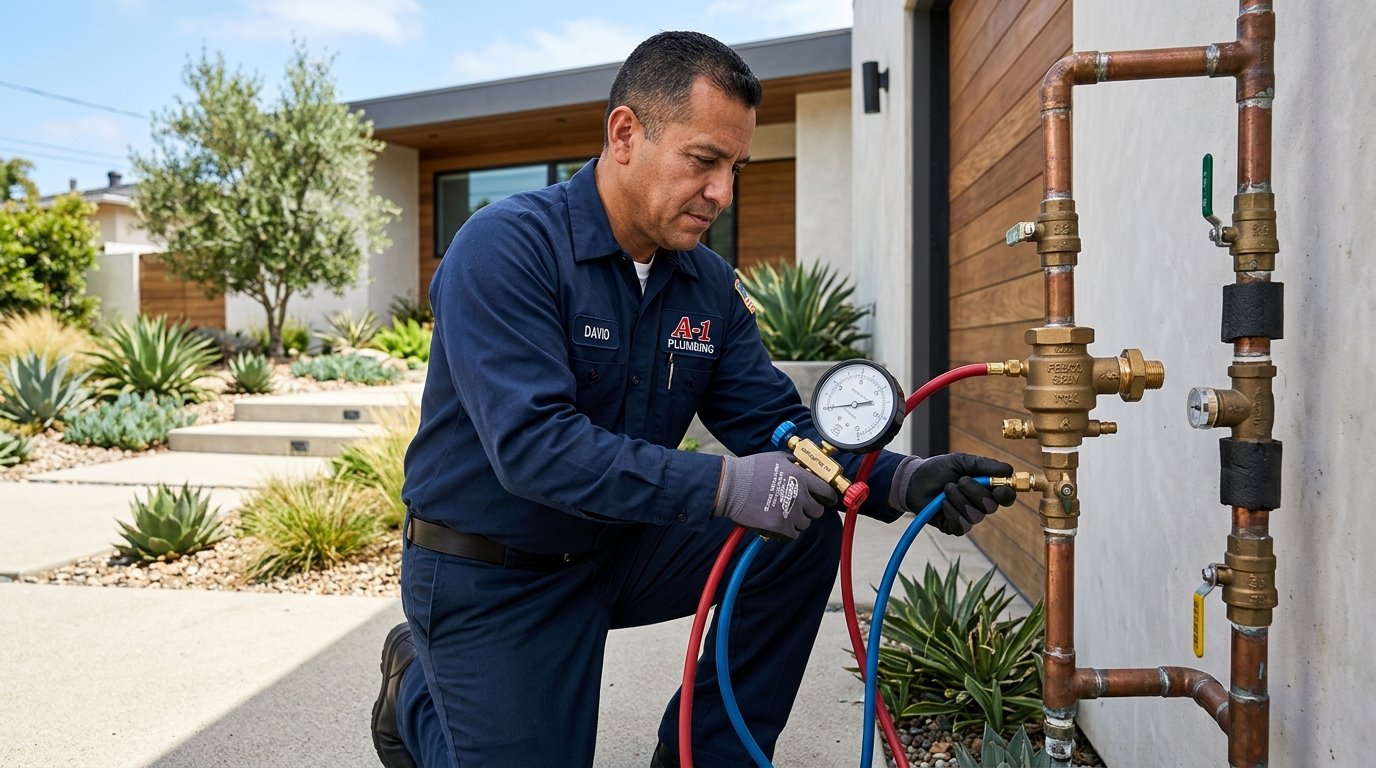
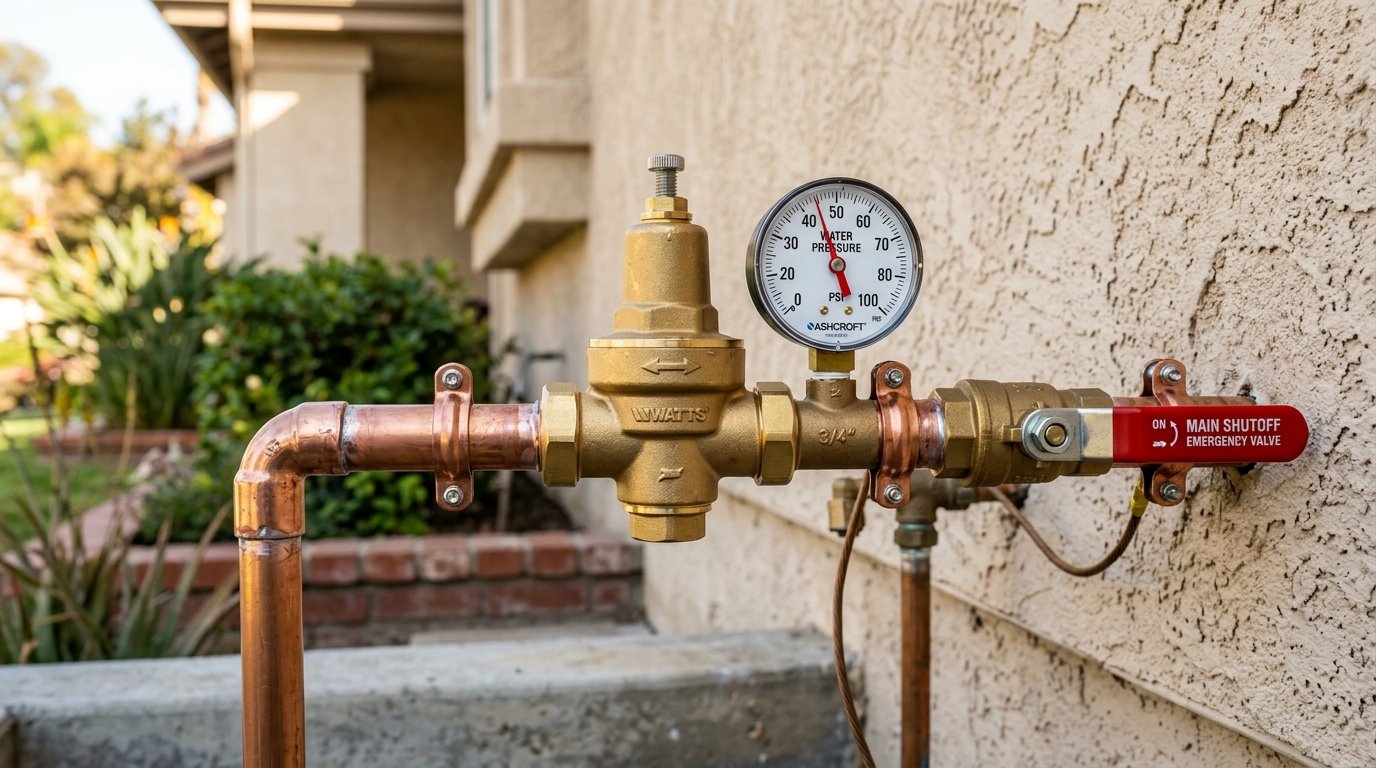
- Pressure Reducing Valves (PRVs): Los Angeles street main pressure frequently exceeds 90 to 140 PSI. California Plumbing Code limits indoor pressure to 80 PSI, meaning almost every home has a water pressure regulator (PRV). PRVs contain a built-in one-way check valve that completely locks water inside the property.
- Backflow Prevention Assemblies: Dedicated irrigation, swimming pools, or fire suppression systems require testable backflow preventers that seal off the municipal line.
- Modern LADWP Water Meters: Utility meters installed in recent years feature internal check valves to prevent contamination of the municipal water grid.
When your closed system water heater fires, thermal expansion has nowhere to dissipate. Pressure rapidly spikes from a comfortable 60 PSI to a destructive 130 to 160+ PSI. This pressure surge forces the safety Temperature & Pressure (T&P) relief valve to weep, stresses copper soldered joints, and ruptures internal washing machine and dishwasher valves.
How a Thermal Expansion Tank Solves the Problem
An expansion tank contains a heavy-duty butyl rubber diaphragm separating a sealed cushion of compressed air from the domestic water supply. When the water heater fires, the expanding water pushes against the flexible rubber bladder, compressing the air cushion and keeping system pressure safely below 75 PSI.
How to Tell If Your Expansion Tank Has Failed
- The Tap Test: Tap the top half of the tank (where air should be) and the bottom half with a screwdriver. The top should produce a hollow ringing ping; the bottom should sound dull. If the whole tank sounds heavy and dull, the internal bladder has ruptured and the tank is waterlogged.
- The Schrader Valve Test: Remove the plastic cap on top of the tank and depress the small brass tire-style Schrader valve needle. If water spurts out instead of air, the bladder is torn and the tank must be replaced.
Cost & Comparison Summary
| System Component | Standard Open System | Closed System Without Tank | Closed System With Expansion Tank |
|---|---|---|---|
| Peak Domestic Pressure | 50 – 75 PSI constant | 120 – 160+ PSI during heating | Controlled 55 – 70 PSI constant |
| T&P Valve Dripping | Never | Frequent / Constant weeping | Dry & Operational |
| LADBS Inspection Verdict | N/A | FAIL (CPC § 608.3 Violation) | PASS |
| Appliance Solenoid Longevity | Normal (10+ Years) | Premature Failure (2–4 Years) | Protected & Normal |
Why Trust SoCal Plumbing 247 for Your Los Angeles Home?
At SoCal Plumbing 247 (CSLB CA C-36), our team brings over 20 years of dedicated master trade expertise to homes throughout Greater Los Angeles and the San Fernando Valley. Whether dealing with stubborn slab leaks, complex gas repiping, municipal sewer laterals, or high-efficiency water heating, we provide upfront flat-rate pricing, zero overtime charges, and fully guaranteed workmanship.
Frequently Asked Questions
Is a thermal expansion tank legally required for water heaters in California?
Yes. Under California Plumbing Code (CPC) Section 608.3 and Los Angeles Department of Building and Safety (LADBS) regulations, a thermal expansion tank is mandatory whenever a water heater is installed on a "closed" plumbing system. Because municipal water meters in LA have check valves and homes are required to have Pressure Reducing Valves (PRVs), nearly all Los Angeles residential plumbing systems are classified as closed.
What is a closed plumbing system?
A closed plumbing system is one where water can flow into the house from the city main, but cannot expand backward into the street because of a one-way check valve, backflow preventer, or pressure reducing valve (PRV). When water heats and expands, pressure builds up inside household pipes with nowhere to go.
What happens if you do not have an expansion tank on a closed system?
Without an expansion tank, thermal expansion creates dangerous pressure spikes exceeding 150 PSI whenever the water heater fires. This causes the Temperature and Pressure (T&P) relief valve to weep, wears out washing machine solenoid valves, stresses pipe joints, causes toilet fill valves to hiss, and drastically shortens the lifespan of your water heater tank.
How much does it cost to install or replace an expansion tank in Los Angeles?
Installing a new thermal expansion tank (typically 2-gallon or 4.5-gallon capacity) during a water heater installation typically costs between $200 and $350. Standalone replacement of a failed, waterlogged expansion tank ranges from $250 to $450 including labor, fittings, and proper code-mandated pipe support strapping.
Need Urgent On-Site Plumbing Help?
Our licensed C-36 technicians provide rapid 30- to 45-minute emergency mobile dispatch across Los Angeles and the San Fernando Valley with upfront flat-rate pricing.
Need an Accurate Upfront Quote for Your Home?
Skip phone tag and surprise contractor fees. Our certified C-36 master plumbers inspect the issue in person with non-invasive diagnostic tools and provide a 100% transparent written quote before any work starts.